

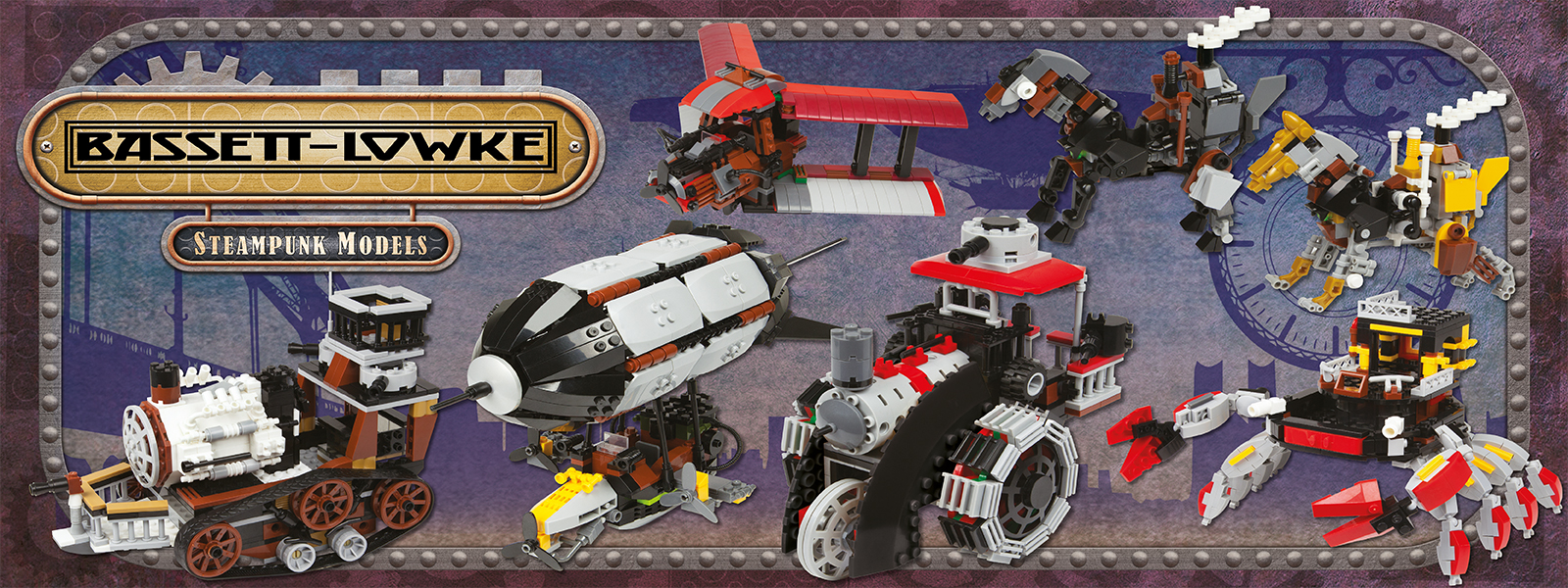
Go behind the scenes with the researcher and developer of the Bassett-Lowke BrickPunk range to learn a little more about the Arachnid Steam Walker, Vortex Tractional Tank and all the other uniquely fascinating BrickPunk models!
In the Victorian age the progress of technology made it seem that little was beyond the scientific minds of the time. Writers were inspired to dream up giant steam powered creatures, that seemed entirely feasible. The 1890's "Electric Bob" series of stories featured all kinds of mechanical marvels including a giant ostrich armed with a cannon. The popular Frank Reade and Jack Wright adventures included robot horses, deers and much more. The alien invaders in the famous 1897 story War of the Worlds by H.G Wells employed massive tripod vehicles.
In reality however the military minds of the era were extremely slow to develop even the most rudimentary machines to be used in front-line warfare. The debut of the tank in 1916 however caused writers to consider how far the concept could be taken. In November that year, The Electrical Experimenter magazine put forward a chillingly realistic proposal for a "Radium Destroyer" which was a machine that was part crab - part grasshopper that could clank towards the enemy and blaze away with an atomic gun. Walking machines of course do not necessarily need to be designed for war. In 1922 American inventor S.T Corbitt patented his design for a "walking tractor" which unfortunately did not make it into production.
In the alternative history of Bassett-Lowke, Brickpunk technology enabled Victorian inventors to create giant walking machines for use in civilian and military applications. They found inspiration from nature, replicating the gait of all manner of creatures. The Brickpunk Arachnid Steam Walker combines aspects of spiders and crabs in its eight-legged, two pincers design.
In the alternative history of Bassett-Lowke, Brickpunk technology enabled Victorian inventors to create giant walking machines for use in civilian and military applications. They found inspiration from nature, replicating the gait of all manner of creatures. The Brickpunk Arachnid Steam Walker combines aspects of spiders and crabs in its eight-legged, two pincers design.
Capable of traversing any terrain and lifting many tons, it is the kind of machinery that is essential in the exciting world of Bassett-Lowke Brickpunk!
When I was asked to create Steampunk inspired models for the Brickpunk range, steam powered mechanical horses came to mind immediately. The development of a mechanical horse has been a fascination for inventors stretching back into antiquity. Realistic steam powered horse models had been produced before the Victorian age came about and it certainty seemed possible to make life sized versions. The Victorian era Frank Reade stories were dotted with mechanical horses and other steam powered wonders. Several patents were registered in the 1800's for mechanical horses but none of them got off of the drawing board.
Ultimately the complexity of creating a mechanical horse for the purposes of pulling and riding was trumped by the invention of much more basic steam-driven wheeled vehicles. In the alternative history of Bassett-Lowke however, the Victorian age led to a series of innovative steps in mechanical horse technology. Inventors embraced the unique qualities of horses and their advantages over wheeled and tracked machines.
In designing the Brickpunk range I wanted to make the Comet Horsebot and Frenzy Horsebot models as authentic as possible. Pipework and exhausts provide a Steampunk look. Both models feature fully articulated legs, and movable necks and heads. The tails can be raised so that the horses can be refueled and spent fuel ejected. I also designed a stand to allow the horses to be posed in a rearing position, or leaping through the air. The building techniques are entirely original but are within the comfort zone of any modeler.
I am sure that people will enjoy building the Horsebot models as much as I did designing them.
I find tracked vehicles to be be very dynamic, so designing a steam powered version for the Brickpunk range was at the top of my list. The combination of huge rolling tracks and the sound and smell of steam power is irresistible. In real life however, attempts at creating tracked vehicles did not become practical until the after the invention of the internal combustion engine. Lincolnshire company Richard Hornsby & Sons patented the Continuous Track in 1904.
Hornsby & Sons produced a working steam powered tracked vehicle - an early version of the magnificent Hornsby Tracklayer but subsequent developments did not utilise steam engines. In the alternative history of Bassett-Lowke, Brickpunk technology allowed Victorian engineers to develop tracked vehicles in the mid 1800's. The almost limitless power of steam allowed machines of immense size and power to be created.
The Brickpunk Vortex Tractional Tank is fully authentic. It includes working tracks, a storage area for fuel and an opening boiler with flames inside. A pair of cannons are vital for defence. The crew can climb to the look-out station by unfurling the safety rail and using it a ladder. Opening doors at the rear lead to a large storage area for tea or other valuable cargo. The model is robust enough to tackle any adventure, which is a good thing because anything can happen in the exciting world of Bassett-Lowke!
Powered heavier-than-air-flight was an obsession of the Victorians. Illustrators such as Harry Grant Dart envisioned aeroplanes that were outlandish in the extreme. For the Brickpunk range I wanted to include an aircraft that had a unique look but based on reality. In 1905 (two years after he Wright Brothers recorded their first flight) a tailless concept with swept back wings was developed by British Army officer J.W Dunne. It was a very strange-looking design but it was credited as the first aeroplane to achieve natural stability in flight. In 1917 the aircraft was produced commercially in the USA and sold to the US Army as the Burgess-Dunne biplane.
It may seem an odd concept today but steam power was initially used in the development of the aircraft. Perhaps the most successful of the experimenters was Clément Ader when he achieved distance of 50 metres in his steam powered Eole aircraft on on October 9, 1890. All of the early aircraft suffered in that the steam engines and fuel, let alone any passengers were too heavy for sustained flight. A method of controlling aircraft was also not invented until the 20th century. In the alternative history of Bassett-Lowke however, Victorian flight pioneers used Brickpunk technology to reduce the weight of steam engines, so that sustained flight became possible. The swept back winged design was a simple but efficient way to construct aeroplanes that were controllable and stable in flight.
The Brickpunk Shockwave Attack Glider features the iconic swept back wing design of aircraft produced at the turn of the century. There are pipes and valves that are invocative of imminence steam power. Sections of the nose can be opened for maintenance. Twin machine guns fire outside of the arc of the propeller. At the rear there is a boiler that can be opened to reveal realistic flames. There is little room for fuel, so the Shockwave Attack Glider has limited flying time before gliding back to the ground. A short flight is all that a skilled pilot requires to mount an attack, so the skies are often a dangerous place in the exciting world of Bassett-Lowke Brickpunk!
There is hardly a greater example of the spirit of Steampunk than airships. There is something magical about those lighter-than-air craft that traverse the air with such grace. The Victorians had dreams of airborne behemoths long before they became a reality, with them being portrayed dominating the skies in illustrations and fiction. There seemed to be no limit on the size and ambition for airships until high-profile disasters in the 1930s, including the infamous Hindenburg caused them to fall out of fashion. Airships by the way, can be built with a rigid framework to maintain their shape, even when emptied of gas (Zeppelins are of this kind). Other airships known as blimps are semi-rigid and non-rigid, that rely on the gas to maintain their shape. Dirigible is another term for an airship, derived from the Latin word dirigere: “to direct.”
Airships are not necessarily giants of the sky and the development of single seat varieties led to an interesting rivalry. American inventor Thomas Scott Baldwin created a pedal powered single-seat airship in 1900 and his next, the California Arrow was powered by a propeller connected to a motorcycle engine. Baldwin was then contracted by an amusement park to create a small airship "The Aerial Rowboat" that could be moved through the air with a large pair of oars, but it only worked by employing a lightweight pilot. Rival inventor Alva L. Reynolds of Los Angeles, California was working along the same lines and called his own oar-driven airship "Man Angel."
Reynolds was so convinced that his craft was the best that he challenged Thomas Scott Baldwin to an airship race. The stakes were high, as the US Army was interested in developing a small airship. Baldwin readily accepted but was forced to withdraw from the competition when the Aerial Rowboat's pilot asked for too much money to take part. Undeterred, Reynolds decided to race a car instead and was confident enough to offer the driver US$1000 if the Man Angel was beaten. On the day of the race, there was such a strong headwind that Reynolds, thrashing furiously with his paddles barely got anywhere while the car easily the winner! Ultimately it was Alva L. Reynolds who earned a contract from the US Army, who paid him US$10,000 to create Signal Corps Dirigible No.1, which was very good money in 1908. The tradition of building one-seat airships has lasted until the modern age.
The Bassett-Lowke Guassian Blimpoid is very much in the spirit of the original aviators. The exposed one-seat cockpit is evocative of early flying machines. Three steam driven propellers allow the craft to reach high speed in flight and can be flexed downward for additional maneuverability. Twin machine guns are vital for defence. The bag holding the lighter-than-air gas features fins for extra stability and is padded to protect it from being fired upon by an attacker. It is best to be prepared when embarking on a flight in the exciting world of Bassett-Lowke Brickpunk!
Steam transportation had become a common sight by the time of the Victorian era, from small horseless carriages up to giant traction engines. The development of steam power on Britain's roads was curtailed however by harsh conditions set out in the Locomotive Act 1865 that limited the size of vehicles and how they could be used. The speed limit was set at a measly 4 mph (6.4 km/h) for turnpike roads and public highways and 2mph (3.2 km/h) for any city, town, or village. In addition someone was required to walk in front of each vehicle waving a red flag during the day or a red lantern at night. Traction engines used in farming and other industries were not only for road use, as they could also be brought to a halt and used for other tasks such as providing to power machinery via a belt feed, or pulling a rope connected to a plough.
The road infrastructure at the time Britain was certainly ill-equipped to handle traction engines. In 1908, an engine that had been employed to pull the trailers of a travelling show to Wooler, Northumberland went off course, demolished the parapet of a bridge and very nearly came to a watery end. In contrast the huge open spaces of countries such as America, Australia and New Zealand allowed traction engines to pull enormous land trains unencumbered by overbearing road legislation or weak stone bridges.
In the alternative history of Bassett-Lowke Steampunk, traction engines and other steam-powered vehicles have been embraced wholeheartedly. Huge improvements to roads have led to the development of land trains, which far outstrip the size and carrying capacity of locomotives, but at a much lower rate of speed however. The very latest in Brickpunk technology has brought the streamlined Scoundrel Tractoid. It features two enormous rolling drive wheels, an opening boiler with realistic flames and defensive weaponry. In order to reach the cab, the crew unfurls the guard rail and uses it as a ladder. Equally comfortable pulling a land train as it is driving independently, it is the kind of transportation that no Bassett-Lowke Brickpunk adventure should be without!